

|
|
              |
updated: 10 March 2013 January 2009 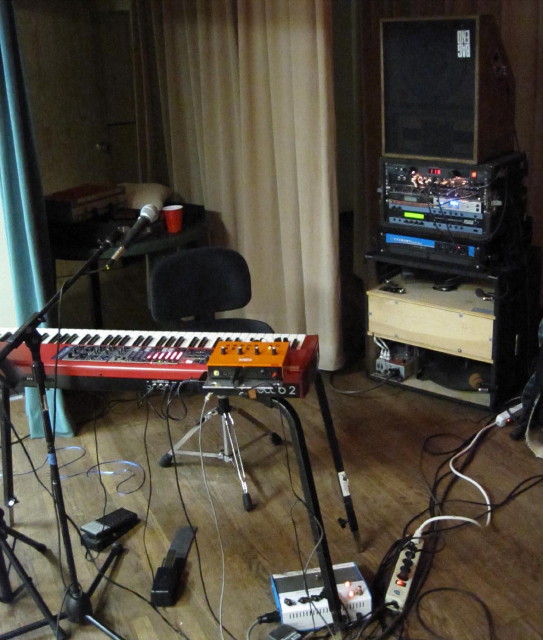
The rig during 2009 - 2011 consisted of:
After years of gigging without drawbars, I finally got around to getting another MIDI Solutions Event processor and programmed it to remap the Voce V5's drawbar controller numbers to those of the Nord. So now I could use the V5's drawbars to control the Nord, and it improved playability significantly. This setup worked, but it was a pain to set up and tear down. I needed to make a shelf for the V5 because it's too deep to fit on the Electro, it requires its own power supply, and the V5 also needs to be modified to supply power to the MIDI Solutions box, and it's just sort of a mess of cables and stuff. I figured there had to be a better way, and I ended up designing and building my own custom drawbar controller which has a nice small footprint, is MIDI-bus powered, and as a result is super easy to set up. This drawbar controller of course is the Ocean Beach Digital DB-1. The Electro2 has a pretty limited number of on-board sounds, but Clavia has a bunch of piano and Rhodes sounds on its website that you can flash into the keyboard via USB, so you can pick and choose what you like best. So the sounds loaded in mine really are the best Clavia has to offer. For really small gigs, I'll bring just the Electro 2 and an amp. For most gigs, I'll bring the setup shown here. The "Pancake" Leslie is called the "Spin Doctor" made by Dr. David Tarantolo in New Orleans. I haven't heard from him in years, I don't know if he's still in business. It uses stock Leslie components, except for the bass rotor and driver. Instead of the usual 15" driver this Leslie uses a 16-ohm jensen C12N, and the rotor is some sort of wooden 12-inch rotor that I think was scavenged from a home organ. When I ordered it I had doubts about the bass response, but speaker technology has come a long way in the 50+ years since the Leslie was first popularized. It sounds just like a conventional Leslie 145, but at about 1/3 the size and weight. I use Speakeasy Vintage Music's most excellent all-tube Leslie preamp, which was a huge improvement over my old Trek II pedal. If you play through a Leslie, I highly recommend investing in the Speakeasy preamp. They're kinda pricey, but it'll make a huge difference in your sound. Lastly, there's the rack, which has a couple sound modules in it and a mic/line mixer. The acoustic piano sound in the Nord leaves a lot to be desired, so I use the sounds in the rack to augment the Nord's sounds. The rack also has some mic preamps in it and a direct box to facilitate interfacing my keyboard setup with the house PA. February 2005 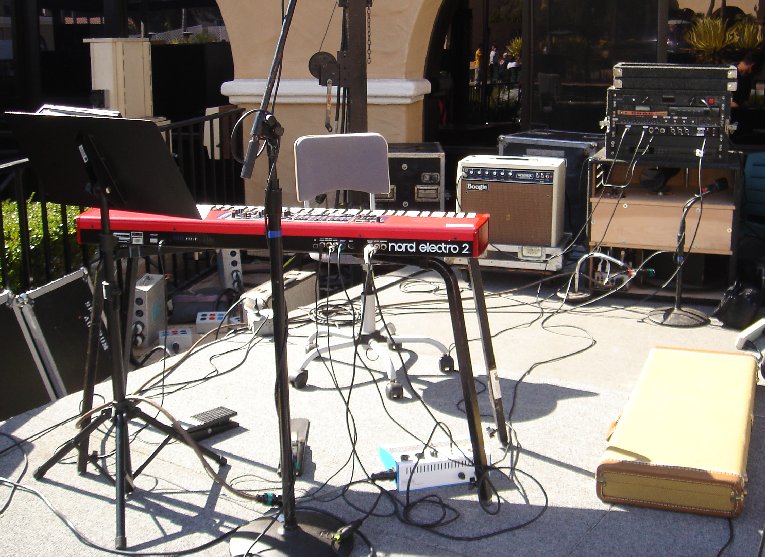
The rig during 2005 - 2008 consisted of:
I had experimented with a few different amps and monitors, and I decided to try playing it though this Mesa Boogie Mark I reissue. In fact, for smaller gigs or gigs with a small timeslot, I'll bring just the Nord and the Boogie, and rely on the Nord's Leslie simulation. It's not bad, and through the Boogie it's pretty convincing. 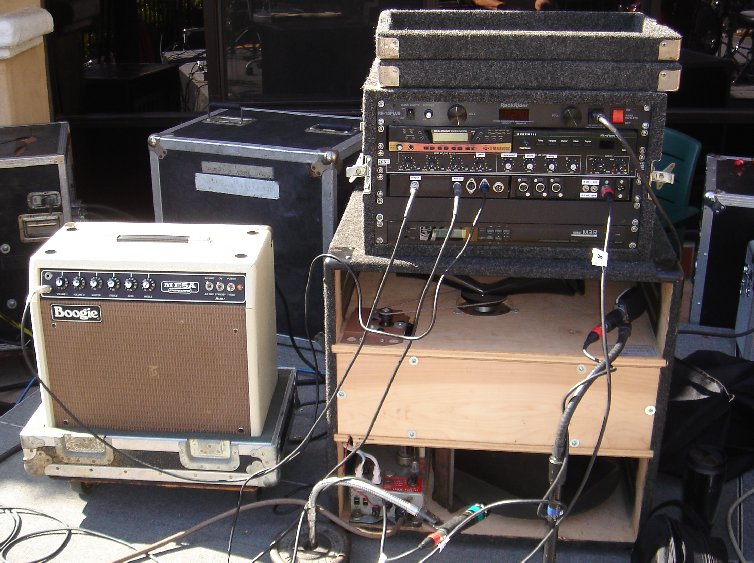
The previous rig
Prior to the current setup, I was using a Roland A-30 as my master controller. I haven't bothered to update the text below,
so everything that's in the present tense is actually in the past. Whatever. Here's a picture of that setup ready for loadin.
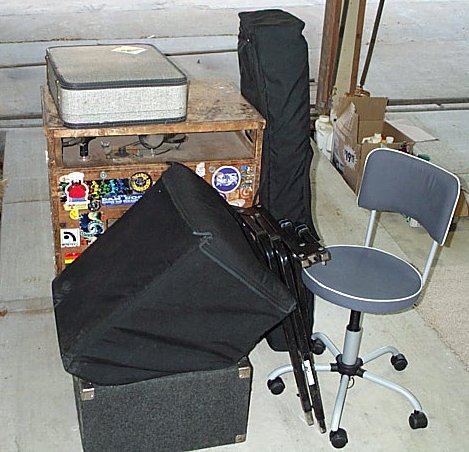
The Roland A-30 serves as both a piano and organ controller, and the A-30s keyboard is actually a fairly reasonable compromise between these two keyboard types. It's very lightly weighted, which is nice for organ, but has enough dynamic touch to get by on piano as well. From front to rear the keyboard is very shallow, 8 or 10 inches or 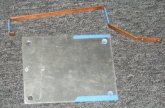 something, so I had to build a bracket on which to mount the drawbar module. At an industrial
metal shop I found some copper bar material which was very easy to work with, and a small
sheet of aluminum.
something, so I had to build a bracket on which to mount the drawbar module. At an industrial
metal shop I found some copper bar material which was very easy to work with, and a small
sheet of aluminum.
 The copper bar hooks onto the front key ledge, goes under the keyboard and supports the
metal plate from the bottom at the rear of the keyboard. The V5 attaches to the
aluminum plate with Velcro. This provides a deep enough shelf for the V5 drawbar module
and also puts it at a comfortable angle. It's quite sturdy.
The copper bar hooks onto the front key ledge, goes under the keyboard and supports the
metal plate from the bottom at the rear of the keyboard. The V5 attaches to the
aluminum plate with Velcro. This provides a deep enough shelf for the V5 drawbar module
and also puts it at a comfortable angle. It's quite sturdy.
The A-30's buttons are a little too accessible, and I keep bumping them by mistake. It's pretty damn embarassing to accidently switch to a random patch in the middle of a song, or worse yet have your keyboard transpose itself into another key. An industrial plastic supply house provided the answer - a hinged clear plexiglas "blast shield" which must be tilted up to access any buttons. You can just barely see the edges of the shield in the photo below. The A-30 can run off of AA cells, or off a wall-wart. The Voce V-5 is also wall-wart powered. Both wall-warts are mounted inside the rack, and supply power to a four-conductor jack on the rack's patchbay. A special cable connects to this and supplies power to both the V-5 and the A-30, so setup is a snap. In fact, all the power connections happen at the rack, so I don't need to deal with power strips or extention cords or anything. In addition to the power connections, the rack's patch bay has MIDI IN and THRU connectors as well as an auxilliary 1/4 inch audio in jack. 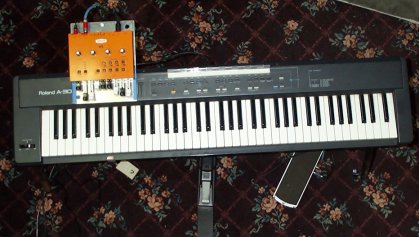
For larger gigs, I'll swap out the Roland A-30 for what's still one of my favorite pianos, the Korg SG-1D (more on that on the acoustic piano page). While the SG-1D is a fine piano controller, the keys are much too heavily weighted for organ work. I have a couple solutions. I have a wooden shelf I built a long time ago, which sits on top of the SG-1D. I can park the A-30 on top of this. This works OK, although it leaves the A-30 a little too high for my tastes. For a short gig, it's OK. If there's enough room, I can use a second keyboard stand and arrange the SG-1D and the A-30 in an L-formation. Another option is to use my Roland PC-88 controller instead of the A-30. It's *tiny* and there's enough room to Velcro it and the V-5 directly to the top of the SG-1D. The resulting keyboard placement is ideal - the piano, organ, and drawbars are all within a very easy reach. The downside is that the PC-88 is only a four-octave keyboard, and doesn't have the best keyboard feel. I don't play much left-hand bass so the length is less of an issue for me than the cheesy synth feel of the keyboard. Still, in a pinch it works fine. A nicety is that the A-30 and the PC-88 both have the same power needs, which means the funky power harness works with either organ controller. While I think it's possible to generate a passable Hammond sound electronically, the same cannot be said for the magic box that is the Leslie speaker. You know, that spinning thing! I have two of them, actually, both model 145. Both of the amps are completely stock except for the addition of Bob Schleicher's solid-state Leslie speed switch. Makes for silent switching of the motor speed, very cool. The Leslie that I gig with has a cabinet that's absolutely beat-to-shit and christened with various stickers, but this is also the sweeter-sounding of the two Leslies. The upper driver is a 1 inch EV horn, and the woofer is a 15" Altec bass driver. The cabinet is miked in stereo with two Sennheiser 604e microphones on the upper rotor and a Shure SM-58 on bottom. The mics are wired into three XLR connectors on the front of the Leslie cabinet. 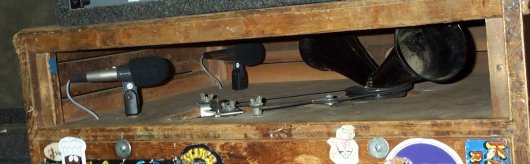
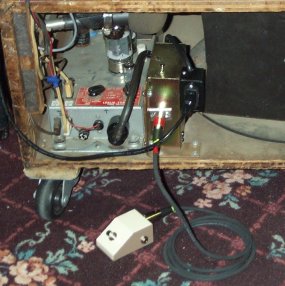
The original reason for mounting the mics inside was to make for quicker setup and teardown, but for the past several years I've been running the miked sound through my rack and into my keyboard monitor. I can hear the Leslie a lot better and play at a lower stage volume. Originally I had only two mics - one SM-48 on the upper rotor and another one on the lower one. At the time I was using a Symetrix mic preamp which only has two inputs. The Sennheisers are a lot brighter. The 604e is a dynamic mic designed for use on drums. It has a similar sound to the Shure SM-57, except with maybe a little more sizzle in the upper midrange. The work well on the Leslie. The mics are isolated from the cabinet using rubber grommets as bushings. Seems to work OK, although I think I could still improve on the mechanical isolation a bit. I've also added windscreens on the mics because there's a considerable amount of wind this close to the Leslie rotors. For larger gigs I still have the option of miking the Leslie the conventional way with the option to use external mics with the rack. Until recently I was using a Trek II combo preamp pedal to drive the Leslie. The Trek II sounded OK, but it's big and bulky. Kind of cumbersome to set up. So, I recently replaced that with a modified XM-47 Leslie preamp. Before the Voce, I was using a Hammond XM-1 organ module with Hammond XM-47 Leslie interface. The XM-47 uses a weird 9-pin DIN cable to interface to the rack unit. It's a great-sounding preamp, and it's tiny. I mounted the little box inside the Leslie between the power amp and the lower rotor. Eventually I sold the XM-1 on eBay, but nobody bought the XM-47. For shits and giggles I started poking around the interface with an oscilloscope and figured out which signals were which. To make a long story stort, I hacked off the 9-pin DIN, cut a hole in the side of the box, and put in an XLR jack. I also bought a little stomp-box type housing for the footswitch. It turned out very nicely - you connect a standard XLR mic cable between the Leslie preamp and the footswitch. The footswitch has a 1/4-inch jack which takes the organ signal off the volume pedal. I was able to get rid of the big ole honking Trek II box, a Leslie cable, a power cable and an extension cord. That's all replaced by the preamp (mounted in the Leslie), a standard mic cable and a foot switch box the the size of a small rodent. Fewer things to carry around! Since the preamp is always connected to the Leslie amp, the fragile 6-pin connector is always protected. To cap it all off, it sounds a lot better than the Trek II setup. I'm really happy with how this worked out. The keyboard monitor speaker is a Bag Eng TA-12BF. I bought a pair of these about eight or ten years ago. At the time I auditioned a bunch of monitors including stuff made by JBL and ElectroVoice, and I found that the Bag Ends have a much smoother sound and flatter frequency response. As a result, I don't have any need for EQ in my rack. Although the rack is always configured in stereo, I have the option to bring one or both monitor speakers - usually I just bring one. Here's what the rack looks like when connected to the Leslie and ready for action: 
COPYRIGHT © 1996-2005 David Chesavage All Rights Reserved |